##
## Call:
## lm(formula = mpg_log ~ hp, data = mtcars)
##
## Residuals:
##      Min       1Q   Median       3Q      Max
## -0.41577 -0.06583 -0.01737  0.09827  0.39621
##
## Coefficients:
##               Estimate Std. Error t value Pr(>|t|)
## (Intercept)  3.4604669  0.0785838  44.035  < 2e-16 ***
## hp          -0.0034287  0.0004867  -7.045 7.85e-08 ***
## ---
## Signif. codes:  0 '***' 0.001 '**' 0.01 '*' 0.05 '.' 0.1 ' ' 1
##
## Residual standard error: 0.1858 on 30 degrees of freedom
## Multiple R-squared:  0.6233, Adjusted R-squared:  0.6107
## F-statistic: 49.63 on 1 and 30 DF, p-value: 7.853e-0890 nichtlineare-regr1
lm
vis
qm2
regression
string
mtcars
computer
Schlüsselwörter
Aufgaben, Statistik, Prognose, Modellierung, R, Datenanalyse, Regression
90.1 Aufgabe
Wir suchen ein Modell, das einen nichtlinearen Zusammenhang von PS-Zahl und Spritverbrauch darstellt (Datensatz mtcars).
Geben Sie dafür ein mögliches Modell an! Nutzen Sie den R-Befehl lm.
90.2 Lösung
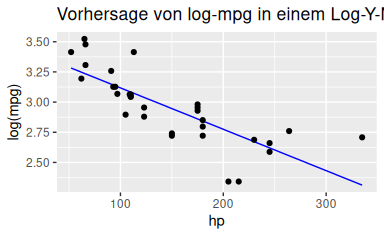
Visualisieren wir die Vorhersagen des Modells:
Oder so visualisieren:
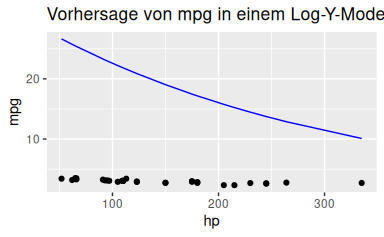
Möchte man auf der Y-Achse mpg und nicht log(mpg) anzeigen, muss man den Logarithmus wieder “auflösen”, das erreicht man mit der Umkehrfunktion des Logarithmus, das Exponentieren (man “delogarithmiert”):
\[\begin{aligned} log(y) &= x \qquad | \text{Y in Log-Form}\\ exp(log(y)) &= exp(x) \qquad | \text{Jetzt exponenzieren wir beide Seiten}\\ y = exp(x) \end{aligned}\]
Dabei gilt \(exp(x) = e^x\), mit \(e\) als Eulersche Zahl (2.71828…).
Categories:
- lm
- vis
- qm2
- regression
- string